
Solid Wood vs. MDF: Which Bathroom Vanity Actually Lasts?
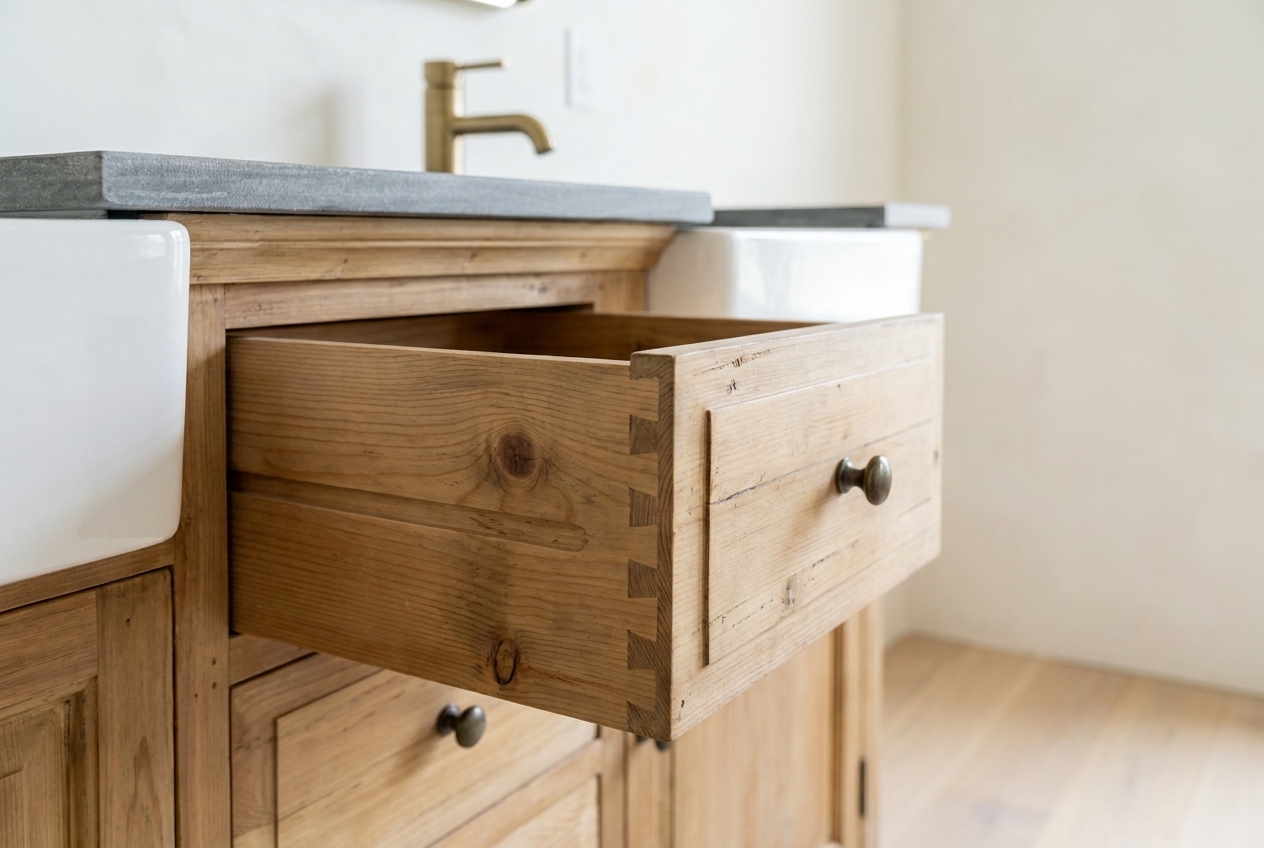
If you are choosing between a solid wood and an MDF bathroom vanity, solid wood is the more durable choice for a room full of water and steam, because it can be sealed, it moves only slightly with humidity, and it can be sanded and refinished for years. MDF costs less on day one and can look perfectly good at first, but once water reaches its core it swells permanently and cannot be brought back.
For a bathroom, solid wood lasts longer and survives real use, while MDF is the budget option that fails first at the edges and around the sink. MDF wins the price tag on the showroom floor and often loses the math over the life of the room, because a swollen panel has to be replaced rather than repaired. We build our vanities in solid reclaimed pine for exactly this reason.
What MDF actually is
MDF stands for medium-density fiberboard. It is wood fibers and resin pressed under heat into a flat, uniform panel. It is dense, smooth, and takes paint beautifully, which is why so many budget vanities are built from it. For a piece of furniture that lives in a dry room, like a bookshelf or a desk, MDF can serve for years without complaint.
A bathroom is not a dry room. MDF's weakness is its core. Once water gets past the painted or laminated surface, usually at a cut edge, a corner, or around the sink cutout, the fibers absorb it and swell. A swollen MDF panel does not dry back to its original shape. It stays puffed, the paint cracks along the seam, and over time the material can soften and crumble. This is the source of most "my wood vanity fell apart" stories. The vanity was rarely solid wood to begin with.
What solid wood actually is
Solid wood is real boards, milled from a single species and joined into a cabinet. It moves a little with the seasons, taking on a touch of moisture when the air is humid and releasing it when the air dries. A cabinet built to allow for that small movement handles bathroom life the way a wood floor or an old interior door does, by flexing slightly instead of failing.
Our vanities are designed in High Point, North Carolina and made to our specifications from solid pine with rustic, reclaimed character. Wood with this kind of age has already spent decades expanding and contracting before it ever becomes a vanity, so it is unusually settled and stable by the time we build with it. You can read more about how we work in our story.
How each one handles bathroom moisture
This is the heart of the comparison, because a bathroom is the hardest room in the house on furniture. Steam from the shower, splashes around the basin, and the daily swing in humidity all put water where it is not wanted.
Solid wood sheds water when it is sealed
Sealed solid wood resists surface water and dries back to its shape after the humidity passes. It is not waterproof, and no wood is, but a properly finished solid cabinet tolerates the steam and the splashing that a bathroom delivers every day. If the finish ever wears thin, it can be cleaned, sanded, and resealed rather than discarded.
MDF swells once the core is breached
MDF holds up only as long as its sealed skin stays perfectly intact. The trouble is that the skin gets breached exactly where bathrooms are wettest, at the base, around the sink cutout, and along cut edges. Once moisture reaches the fiber core, the swelling is permanent. There is no sanding it back.
Longevity and repairability
A solid wood vanity is a repairable object. Scratches sand out, finishes renew, and a loose joint can be reglued. That is why solid pieces are passed down and refinished rather than thrown away. A reclaimed solid vanity carries that further, since the wood already lasted a generation or more before it reached your bathroom.
MDF is not repairable in the same way. A swollen panel is finished, and the usual outcome is a full replacement. The longevity gap between the two materials is not subtle in a wet room. Solid wood is measured in many years and can be refreshed, while a failing MDF vanity is often measured in a handful.
Weight and feel
You can feel the difference before you read a single spec line. Solid hardwood and dense softwood are heavy. A solid vanity has mass, drawers that close with a settled weight, and edges that show continuous grain wrapping the corners. MDF is lighter for its size, sounds hollower when tapped, and shows a smooth, printed, or painted face with no grain running through the edge.
The cost difference
MDF wins the price comparison on the showroom floor. It is cheaper to produce and cheaper to buy, and for a tight budget in a dry, well-ventilated bathroom it can make sense for a while. The catch is what happens next. If an MDF vanity swells and has to be replaced in a few years, you pay for the vanity twice, plus the labor and the disruption of swapping it out.
A solid wood vanity costs more at the start and earns it back over the life of the room. It can be sanded, refinished, and kept for many years, and a reclaimed piece was built from wood that had already lasted decades before you bought it. There is an environmental side to that too, since keeping one well-built piece in service is far gentler than replacing a cheap one on a cycle.
How to tell them apart when shopping
Online, the listing does not always make it obvious, and the photos look the same. A few reliable ways to check what you are actually buying:
- Read the materials line, not the headline. "Wood finish" or "wood look" usually means it is not solid wood. Look for "solid [species]" and a stated wood for the interior, not just the door fronts.
- Check the drawer box. Pull a drawer out and look at the corners. Dovetail joints and solid-wood sides are a strong sign of real construction. Stapled or glued corners over pressed board are a tell.
- Look at the edges and inside the cabinet. Real grain that runs continuously around an edge means solid wood. A printed surface that stops at the edge, or a smooth uniform core, points to MDF or veneer.
- Weigh the price against the size. Solid hardwood is heavy and is rarely cheap. A large "wood" vanity at a very low price is almost always MDF or veneer over a pressed core.
- Ask a direct question. A maker who builds in solid wood will tell you plainly what the cabinet and the drawers are made of. If you cannot get a straight answer, that is an answer.
Why we build in solid reclaimed pine
Two vanities can both say "wood" and be built nothing alike. The joinery is what decides whether a piece survives a bathroom, so that is where we put the work. Our drawer boxes are joined with interlocking dovetails that stay square over years of use. Our interiors are solid wood, not veneer over a pressed-board core, so there is no hidden MDF waiting to swell. Our panels are built to move slightly without splitting, and the base is built true so the whole cabinet sits and stays level.
We choose reclaimed pine because age makes wood stable. It has already done its expanding and contracting, it carries a character no pressed panel can fake, and it gives you a vanity that handles real bathroom life instead of merely looking the part on day one. That is the whole reason we build the way we do.
- Moisture
- Solid wood sheds water when sealed and dries back to shape. MDF swells permanently once the core is breached.
- Lifespan in a bathroom
- Solid wood lasts many years. MDF often fails at the edges and base in a few.
- Repairability
- Solid wood sands and refinishes. A swollen MDF panel cannot be restored.
- Cost
- MDF is cheaper up front. Solid wood costs more at the start and earns it back over the life of the room.
- Weight and feel
- Solid wood is heavier, with grain wrapping the edges. MDF is lighter, with a smooth printed or painted face.
Frequently Asked Questions
Is MDF or solid wood better for a bathroom vanity?
Solid wood that is properly sealed lasts longer in a bathroom and resists moisture damage far better than MDF, which can swell and crumble if water reaches the core. MDF costs less up front but is harder to repair.
Does MDF hold up in a bathroom?
MDF can work for a while if it is well sealed and never exposed to standing water, but once moisture reaches the core it swells permanently. Solid wood is the more durable choice for a wet room.
How can I tell if a vanity is solid wood or MDF?
Check the weight, look at the edges and inside the cabinet for real grain rather than a printed surface, and lift a drawer to see the joinery. Solid wood feels heavier and shows continuous grain on edges.
See the difference in person.
Every vanity we build is solid reclaimed wood, sealed for the bathroom and made to order.
Shop Our Vanities